

RC Airplane Propeller Size Guide: Choosing the Right Prop
Welcome to the ultimate RC airplane propeller size guide. If you're new to the radio control flying hobby, choosing the right propeller for your RC plane can quickly feel like navigating a minefield. With so many numbers, materials, and blade counts, how do you know which one is best?
Selecting the correct RC plane prop size is absolutely crucial if you want to get the optimum performance from your aircraft, regardless of whether you fly electric RC airplanes or internal combustion (IC) models. In the worst-case scenario, fitting the wrong size propeller can cause serious, irreparable damage to your plane's components. This is especially true for electric-powered RC airplanes, where over-propping can quickly burn out your motor or electronic speed controller (ESC).
In this guide, we'll break down exactly what propeller pitch and diameter mean, how they affect your plane's speed and thrust, and how to read an RC propeller size chart.
But before we get into the details, remember the first and most important rule of thumb: always start by following the manufacturer recommendations for the specific engine or motor you have installed. Most model airplane engines and brushless motors will come with documentation stating a safe range of suitable propeller sizes.
Let's dive into the basics of how to choose the right RC airplane propeller so you can get airborne with complete confidence!
RC Plane Prop Basics
You'd be forgiven for just thinking of your rc plane's prop as the thing that pulls the plane along, but understanding a bit about exactly how propellers actually work is no bad thing.
Simply put, props are nothing more than vertically mounted rotating wings. The prop's job is to convert the motor power in to thrust, to pull/push the plane through the air. Thrust is generated in exactly the same way as lift is generated by the wing, and that's why props have a profile airfoil section.
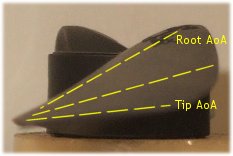 The 'twist' in the propeller is there to create the essential Angle of Attack of each blade, just like a wing has an AoA. The twist is greater towards the hub of the prop because of varying airspeeds along the length of the blades, and hence varying thrust generation. The picture to the right approximately illustrates how the Angle of Attack varies along the blade length.
This difference in thrust occurs because the tips of the prop blades move faster than the inner portions of the blades, so the AoA has to change accordingly along the length of the blades; more thrust is generated at faster speeds, just like more lift is generated over a faster moving wing. At slower speed (i.e. nearer to the hub of the propeller), the AoA has to be greater to generate a similar amount of thrust being generated at the faster moving tips.
RC Propeller Size Labelling
All rc propellers are designated two measurements, traditionally given in inches.
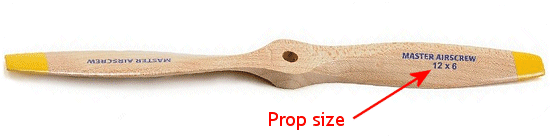
The first number is the arc diameter created by the spinning prop i.e. propeller length from tip to tip. The second number is the pitch and this is the harder of the two to understand - but we'll give it a go...
Essentially, diameter determines the 'grunt' and pitch determines the speed of the plane.
Pitch indicates how far, in inches, that propeller will move through the air per single revolution of the engine (i.e. every single complete turn of the prop). However, the pitch measurement must only be taken as a guideline because real-life factors influence the actual distance eg the prop material, its condition, efficiency, air density on the day etc.
So pitch measurement is really only a theoretical value, but it is good enough to help you choose the right size propeller for your airplane's performance requirements.
One way to understand propeller pitch is to imagine the gauge of two different screw threads, coarse and fine, both being screwed into a piece of wood at the same rotational speed. The screw with the coarse thread will cut into the wood faster than the fine threaded screw will.
It's the same for propellers 'cutting' through the air (hence the reason why propellers are sometimes called airscrews).
In the illustration below, the two arrow lines represent the path of each propeller tip. You can see that the higher pitch prop (eg 10x8) takes only one and a half turns to cover the same distance that the lower pitch prop (eg 10x4) takes 3 turns to. So, with both engines and props spinning at identical RPM, and everything else being equal, the higher pitch prop will travel further in the same amount of time - hence a faster flying plane.
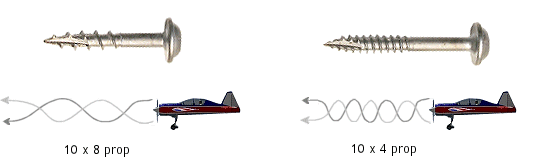
So you can see that selecting a different propeller pitch size is going to significantly change your airplane's performance, with speed being the primary factor.
The diameter of the propeller (10" in the example above) will also effect how the airplane flies, but also how the engine runs. One common mistake beginners make is ignoring the pitch vs. diameter trade-off. If you want to increase the diameter of your prop for more thrust, you usually need to decrease the pitch to prevent your motor from drawing too many amps. You can't simply increase both without risking an overheated ESC or motor. Again, following your engine manufacturer's recommendations is the place to start.
RC Propeller Materials
Beyond pitch and diameter, the material your propeller is made from will also heavily impact your RC plane's performance. Here's a quick breakdown of the most common materials you'll come across:
- Plastic / Nylon: (e.g., APC, Master Airscrew). These are the most common and arguably the best choice for beginners. They are highly durable, inexpensive, and have just enough flex to survive minor nose-overs or rough landings without snapping immediately. Grabbing a multi-pack of APC nylon props is a great way to get started so you always have spares at the field.
- Wood: Wooden props are very lightweight, which allows your motor or engine to spool up (accelerate) faster. They are incredibly popular with gas RC airplanes and glow engines. The major downside? They are rigid and brittle, meaning they will easily snap if they strike the ground.
- Carbon Fiber: The premium choice. Carbon fiber props are ultra-stiff, highly efficient, and lightweight. They won't flex under high RPMs, making them the go-to for giant scale models, 3D aerobatics, and high-performance racing. However, they are expensive and can cause serious damage to your motor shaft if you strike the ground, as the prop won't break to absorb the impact.
Be Noise Aware!
Prop diameter directly influences the amount of thrust generated, but an ever-increasing and non-performance related issue these days, linked to rc airplanes, is that of noise.
A faster turning propeller (and props can easily turn in excess of 10,000 RPM) generates a lot of noise as the tips cut through the air. In fact, when you hear an rc airplane flying it's more than likely the propeller that you're hearing more than the engine.
A larger diameter prop reduces the engine's RPM at any given power setting, because there is more for the engine to turn over and hence more work to do. Slower turning props generate less noise, so larger diameter props run quieter than smaller diameter props, all else being equal.
In this environmentally-sensitive world that we live, this is a serious consideration when selecting a propeller, especially if your flying site is 'noise sensitive' (eg close to houses etc.).
IC Propeller Size Recommendations
As already mentioned, following the prop size recommendations made by your engine manufacturer should always be your first point of reference. But there are generally recognised prop size ranges for each engine size and these are the sizes to choose if you're unsure about propeller selection.
The following propeller size chart (© Top Flight, reproduced with permission) is easy to use; select your IC engine displacement along the bottom scale, then follow the vertical line up to the shaded area to give the prop size range for that engine.
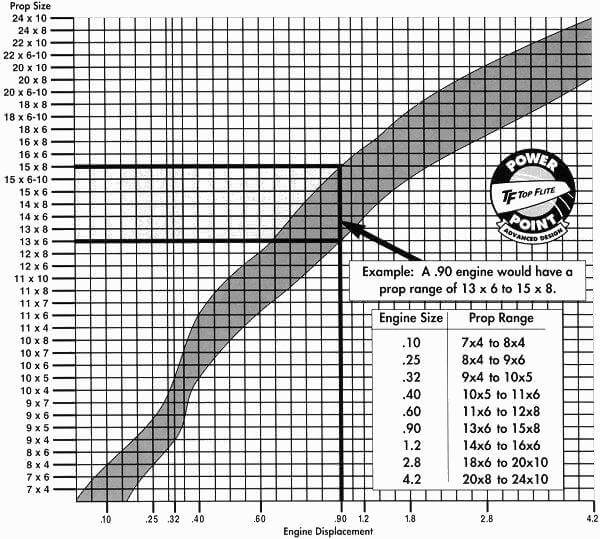
Although this chart is related to Top Flight's Power Point range of props, the size ranges suit all brands.
EP Propeller Sizes
Matching a prop to an IC engine is easy if you follow the general recommendations outlined in the above chart, which have long been accepted in the hobby. Fitting an incorrect prop would mean the engine would still run, but your plane would perform poorly.
But with the advent of electric power (EP), propeller selection became a whole new minefield!
EP prop selection is much more critical because different combinations of motors, ESCs and battery packs can generate huge differences in operating speeds and loads.
As with IC, electric motor manufacturers give a specific propeller size range for their motors but it's more critical that the range is adhered to. Over-propping can do irreparable damage to electric motors and particularly ESCs, because an oversized propeller will force the motor to work harder than it was designed to.
If you put an oversize prop on an IC engine, the engine will likely stop running. No harm done. But put an oversize prop on an electric motor and the motor will just keep on trying to turn the prop.
The motor will draw more and more current as it tries to keep up with its Kv rating (the number of RPM it has been designed to turn, per each volt fed into it). With too big a propeller, the motor will just keep working harder and harder to spin the extra load, until something (likely the ESC) overheats and catches fire.
Too small a propeller on an EP motor won't do any damage, but you won't get the required performance from your plane. The motor will draw less current and the plane will likely be seriously under-powered.
Use a Watt Meter
The only accurate way to know whether or not your EP propeller is resulting in the correct current draw through the ESC is to use a digital Watt meter connected between battery pack and ESC, as the video below shows...
Watt meters don't cost much money and they are simple to operate; a test takes only a few minutes and will give you solid peace of mind. Personally, if you're an EP flyer, I would say that a Watt meter is as essential as your battery charger!
Number of Propeller Blades
 Most propellers used in the rc flying hobby have two blades, but props with three or even four blades are available.
Two-bladed propellers are commonly used because they are actually the most efficient and easy and cheap to produce. But sometimes an rc airplane will call for more blades, particularly where "scale realism" is required to make a model warbird look like the real thing, or when a plane has short landing gear and a standard 2-blade prop would strike the ground.
Adding more blades decreases the overall efficiency of the prop because each blade has to cut through more turbulent air from the preceding blade. In fact, a single blade propeller is the most efficient but these are rarely (almost never!) seen in our hobby although they have been experimented with. A single blade prop must be balanced with a counterweight on the other side of the hub to the blade, otherwise the plane would shake itself to pieces as soon as the prop was turning!
If choosing a three or four bladed propeller over a two bladed one, a very general rule of thumb is to decrease the prop diameter by an inch and increase the pitch by an inch. That said, fuselage and ground clearance issues might dictate which propeller size you can and can't have on your plane. As with everything, trial and error is going to play a part in your propeller selection.
Installing and Balancing Your Propeller
If you're upgrading or replacing your RC airplane propeller, there are a couple of classic beginner pitfalls to avoid during installation. The most common mistake is mounting the prop backwards. An RC propeller is an airfoil, just like your wing. If you mount it backwards, it will still generate thrust, but it will be incredibly inefficient and your plane will barely fly. Always ensure the numbers (size/pitch) printed on the hub are facing forward, toward the direction of flight.
You may also find that different motors have different shaft diameters. If your new prop's center hole is too small, don't force it or use a standard drill bit, as you'll likely drill it off-center. Instead, use a stepped propeller reamer tool to perfectly enlarge the center hole so it fits your motor shaft snugly and perfectly centered.
Finally, never skip balancing! Even brand new props direct from the factory are rarely perfectly balanced. Running an unbalanced prop will cause severe vibrations that can tear apart your motor bearings, loosen airframe screws, and ruin the video quality if you fly FPV. Always use a magnetic propeller balancer before fitting a new prop to your plane.
Beware the Biting Prop!
Never ever underestimate the potential for an rc plane propeller to do serious damage.
There are countless stories of model pilots losing fingers, or suffering horrendous lacerations to skin on their hands and arms. Even a small size plastic propeller can hurt and cut skin, so imagine what the bigger ones can do.
Always take great care around a spinning prop and treat it with the utmost respect. Keep hands and fingers well clear and never become complacent.
If you want some gory evidence of what props can do, just Google "rc propeller injuries" and you'll soon see. Keep safe!
Well hopefully this article has given you an understanding of propellers used on rc airplanes, and an idea of how to select the right size propeller for your model.
Remember to follow your engine/motor manufacturer recommendations whenever you can, and use a Watt meter if you are going to experiment with different propeller sizes for EP rc planes.
Common Questions About RC Propeller Sizes
What do the numbers on an RC airplane propeller mean?
The numbers represent the propeller's size in inches, usually formatted as Diameter x Pitch (e.g., 10x6). The first number is the diameter (the total length from tip to tip). The second number is the pitch (the theoretical distance the prop will pull the plane forward in one single revolution).
Can I put a bigger propeller on my RC plane?
Yes, but you must be careful. On an electric plane, a larger diameter or higher pitch propeller will force the motor to work harder, drawing more electrical current (amps). If the amp draw exceeds the rating of your ESC or motor, they will overheat and catch fire. Always use a Watt Meter when testing larger props. On an IC engine, a prop that is too large will cause the engine to bog down, overheat, and stall.
Are wood or plastic propellers better for beginners?
Plastic (or nylon/glass-filled) propellers are much better for beginners. They are cheaper and have a slight amount of flex, meaning they can often survive minor nose-overs or bumpy landings without breaking. Wooden props are rigid and will snap easily if they clip the grass or tarmac.
You might also like to read about...
 Breaking in a glow plug engine.

All of this and much more is covered in our Beginner’s Guide 👇
The Beginner’s Guide To Flying RC Airplanes is a 139-page, easy-to-read e-book written for complete newcomers. It explains exactly what to buy, where to fly, and how to avoid costly mistakes.
📖 Start reading now