

RC Helicopter Controls Guide: How to Fly an RC Heli
Welcome to our ultimate guide on RC helicopter controls. If you are just transitioning from airplanes or getting started in the radio control heli hobby from scratch, understanding the different pitch controls (cyclic vs. collective) and how everything interacts can feel a bit like learning a new language.
 Hopefully, this article will sort that out for you, if you've been scratching your head about it!
Getting a firm knowledge of how an RC helicopter maneuvers will give you a sure footing in your early days of learning to fly one. Because helis are inherently more complex to fly than fixed-wing planes, I also highly recommend picking up an RC flight simulator to practice these controls safely on your computer before taking your real model to the field.
Let's start with understanding the most important concept: pitch...
The primary method of making a real helicopter change direction while flying is through full pitch control of the main rotor blades, either independently or collectively.
But in the radio control flying world, there are many electric rc helicopters that do not have this complete independent pitch control. These are known as fixed pitch (FP) rc helicopters and have proven to be very popular with beginners.
Emulating the real helicopters are the more complex collective pitch (CP) models which, although much harder to learn on, are more agile and smoother to fly because the rc helicopter controls found on them are truer to life.
Understanding Cyclic vs. Collective Pitch
To control a helicopter's direction, the pitch angle of the main rotor blades must be changed in relation to the air flowing over them. This change varies the amount of lift generated by the blades in different areas of the rotation.
Pitch angle is referred to as Angle of Attack when the blade is moving through the air.

Main rotor blade control comes in two forms, cyclic and collective.
Cyclic controls directional movement of the helicopter (left, right, back and forward) whilst collective controls altitude (up, down).
Cyclic control changes the pitch angle of the whole rotor disc, which is the imaginary circle drawn in the air by the tips of the spinning blades. Imagine a dinner plate spinning round on a pole, and tilting up and down slightly as it spins - this is effectively what the rotor disc does when cyclic control is applied.
The rotor disc movement is also affected (helped) by the flybar*, a short bar perpendicular to the main rotor blades.
At each end of the flybar is an airfoil paddle. The flybar moves in direct response to the tilting of the swashplate, which is controlled by the servos. A flybar also acts to stabilise the helicopter in flight.

Above: the rotor head assembly of a fixed pitch rc helicopter.
As the flybar rotates in response to the tilting swashplate, so the Angle of Attack of the paddles changes. This effects the amount of lift being generated by them and so they rise and fall accordingly.
The paddles always work against each other i.e. if one rises then the other is forced downwards, and vice versa.
This rise and fall of the paddles exaggerates the movement of the flybar assembly, and the end result is that the whole rotor disc tilts in response to the changes in lift being experienced at the paddles.
As a result of that, the helicopter leans to the side that is experiencing lesser lift, thus changing sideways and/or fore-aft direction.
While flybars have been almost universally used on rc helicopters for many years, flybarless systems are now very common. More on those further down the page.
Fixed Pitch (FP) vs. Collective Pitch (CP)
A very common question beginners ask is: "Which is better for me to learn on, fixed pitch or collective pitch?" To answer that, it's important to know that the terms 'FP' and 'CP' are a little misleading because both terms only refer to the collective pitch control (altitude) of the helicopter. The cyclic pitch control (directional) method is basically the same for both.
The primary difference between fixed pitch and collective pitch rc helicopters is purely in the collective pitch control—how they gain and lose altitude.
On a fixed pitch rc helicopter, the main blades are fixed firmly in the main rotor blade holder and cannot be pivoted about their longitudinal axis (twisted).
Altitude, therefore, has to be controlled exclusively by the speed of the blades - faster spinning blades generate more lift to climb, and slower spinning blades generate less lift to descend.
The speed of the blades ('head speed') is controlled by your throttle stick altering the motor speed.
The big problem with fixed pitch altitude control is that of latency. There can be an annoying lag between you moving the throttle stick of your transmitter to change the motor speed, and the actual change in lift generation happening. As a result, trying to hold a perfectly consistent altitude is very tricky for a beginner. FP helicopters will often rise and fall repeatedly, despite your best efforts!
On a collective pitch rc helicopter, however, the main blades can be pivoted (twisted) about their longitudinal axis in relation to the rotor head.
This dynamically changes the pitch angle of the blades while they are spinning, and hence the associated amounts of lift.
Because of this, the motor can be kept at a constant, high speed, and altitude is controlled solely by changing the pitch angle of the blades.
This set-up gives much more agile flight performance and instantaneous response. Altitude control is so much easier and more precise, compared to an FP heli. This is exactly how full-size helicopters operate.

Above left, an FP rotor head compared to the more complex CP one, right.
Collective pitch control is strictly necessary for any form of aerobatic flying, especially inverted (upside-down) flight where negative blade pitch is a necessity to push the helicopter "up" while it is upside down.
A fixed pitch rc helicopter, on the other hand, is severely limited in terms of aerobatic capability. However, because FP helis are mechanically much simpler, they are much cheaper to repair when you crash—which makes them fantastic beginner trainers.
RC Helicopter Controls & Channels
For a traditional rc helicopter to have proper control there needs to be at least 4 channels - left/right cyclic, fore/aft cyclic, left/right yaw and collective pitch and/or throttle.
If these terms sound confusing, compare them to the 4 primary airplane controls and you'll quickly see the relationship:
| Helicopter Control | Airplane Control | Action |
| left/right cyclic | left/right aileron | roll |
| fore/aft cyclic | elevator/thrust* | airspeed |
| left/right yaw | left/right rudder | yaw |
| collective pitch/throttle | elevator/thrust* | climb/dive |
*NB Airplane elevator and thrust are shown together because
both influence airspeed and climb/descent.
Taking a basic 4-channel FP rc helicopter as an example, there will be 2 servos controlling the cyclic pitch - one for left/right and the other for fore/aft. Main motor speed control and tail rotor motor speed (left/right yaw) will be the other two channels.
Yaw is controlled by the tail rotor and is used in conjunction with, or against, the natural torque force that is generated by the spinning main rotors. (As a natural physical reaction to the heavy spinning blades, the fuselage of the helicopter will always want to spin in the exact opposite direction).
The tail rotor generates sideways thrust in the same way as an airplane propeller generates thrust. If the amount of sideways thrust equals the level of torque being generated from the spinning main blades, then the helicopter fuselage holds straight and won't spin round. If the thrust exceeds the torque, the fuselage will yaw one way, and if the torque exceeds the thrust then the fuselage will naturally yaw the other way.
The RC Gyro
Alright, so what does a gyro actually do on an RC helicopter?
 The use of yaw control in rc helicopters is made infinitely easier by a gyro, which is an electronic device connected between the receiver and the tail rotor control (either a tail servo or a small tail motor).
The gyro, technically a form of accelerometer, senses any rotational movement of the helicopter's tail that isn't a direct result of a command signal from the pilot's transmitter. It then makes fine, rapid adjustments to the tail rotor speed or blade pitch to perfectly counteract the torque force at that precise moment, dampening out any unwanted yaw.
Gyros make these calculations and corrections at lightning speed, so much so that the pilot doesn't notice anything other than a perfectly stable helicopter!
The gyro sensitivity ('gain') can be adjusted by the pilot either directly on the gyro itself or remotely from the transmitter.
Heading Hold Gyros (HHG) go one step further than a standard rate gyro by performing more complex calculations to keep the helicopter pointing exactly in the direction that the pilot intended.
A HHG will 'learn' the orientation of the helicopter and maintain this heading until the pilot inputs a definite yaw control that overrides the gyro. Once a signal has been received from the transmitter, the gyro learns the new heading and locks the heli pointing in that direction until a new command is received.
Heading Hold Gyros more or less eliminate unwanted changes of direction forced on the helicopter by wind gusts. Without a HHG, the wind pushing on the tail will naturally force the helicopter to swing around like a weather vane. The HHG prevents this because it knows the change in yaw did not come from the pilot's stick. Clever stuff indeed!
HHGs, once an expensive luxury, are now commonplace and almost all modern rc helicopter gyros have this feature built-in.
RC Helicopter Control Units
 Many smaller rc helicopters use micro-processor controlled printed circuit boards (PCBs) to save space and weight.
The PCB-based unit is a device that can potentially (depending on the helicopter type) combine the receiver, gyro and motor electronic speed control (ESC) all into one small brick. A further function can be pitch mixing, again depending on the helicopter in question.
Separate components can of course be used, and often are, when the helicopter is big enough to carry the extra weight without problem. But on smaller RTF electric helis, particularly the cheaper fixed pitch models, a 3-in-1 or 4-in-1 control unit is almost always used to save weight, space, and wiring.
CCPM
CCPM stands for Cyclic/Collective Pitch Mixing and is commonly found on modern electric powered CP helicopters, where it's sometimes called eCCPM.
The swashplate has three servos controlling it (aileron, elevator and pitch), typically spaced at 120° to each other around the main shaft. The servos all seamlessly interact together to control both cyclic and collective pitch simultaneously as the inputs are made by the pilot.
The mixing is usually done at the transmitter, meaning a computer radio is needed for this function to be available.
CCPM setup can be quite daunting to the beginner rc helicopter pilot, and it's important that the setting up of the servos is done correctly and well. All servos must match exactly and linkage lengths must also match perfectly, so that all servos can work together equally to raise, lower, and tilt the swashplate without binding.
Coaxial RC Helicopters
If you are just starting out, you might be looking at a Coaxial heli. Coaxial rc helicopters have 2 sets of main rotors mounted one above the other, and absolutely no tail rotor.
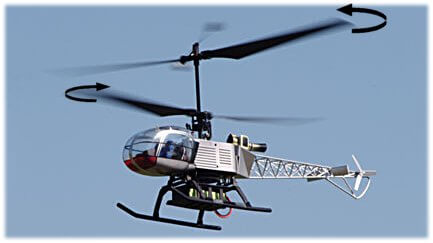
The main rotors spin in opposite directions to each other, thus completely cancelling out each other's torque force. So, because there is no torque when both rotors are spinning at the same speed, the fuselage of the helicopter has no tendency to spin round in any particular direction.
Directional control is achieved by changing the speed of one of the rotors in relation to the other. In doing so, a small amount of torque is then generated and that unbalanced force will naturally cause the helicopter to yaw one way or another, hence changing direction. Because of their inherent stability, grabbing a beginner-friendly coaxial RC helicopter is one of the easiest and most stress-free ways to learn how to fly rotary-wing aircraft indoors.
Coaxial rc helicopters are fixed pitch and so altitude is controlled by adjusting the motor speed and hence the main rotor RPM, thus changing the associated amounts of lift generated.
Less Controllable 2-Channel RC Helicopters
 You will find many 2-channel toy rc helicopters in mall kiosks and online, but be warned: they aren't very controllable, and you need to be aware of this when considering buying one.
The 2-channel helis have no pitch control whatsoever - only main and tail motor speed control, and sometimes this might only be a simple on/off function for the tail.
Their simplicity means they are incredibly cheap to buy, which is great, and they are still good fun to fly around the living room, but they don't give you an accurate experience of flying a true radio control helicopter.
The downside to such helicopters is that the torque force is only vaguely compensated, and as a result the helicopter will often spin round during flight, particularly when motor speeds are changed.
But with some degree of trimming and tweaking, it is possible to get them flying in wide circles in a controlled way to produce some realistic looking flights.
With any 2-channel rc helicopter the controls are very basic and so stable, precise hovering is pretty much out of the question - but they're still a blast for the price!
Flybarless (FBL) RC Helicopter Control
As previously mentioned, the biggest change to radio control helicopter control in the modern era is the advent of flybarless (FBL) systems.
The change is due to incredible technological advancements in recent years, allowing manufacturers to produce multi-axis electronic stabilization units.
These are essentially the same as the gyros used to soften the yaw control on the tail, except they work on all 3 axes (pitch, roll, and yaw). A modern flybarless stabilization system constantly monitors the helicopter's attitude and makes micro-adjustments to the servos thousands of times a second to keep the heli perfectly stable without a physical flybar.
A flybarless rc helicopter has a much more realistic, scale look (since full size helis don't have flybars!) and the rotor head is mechanically less complex to repair, due to the much lower component count.
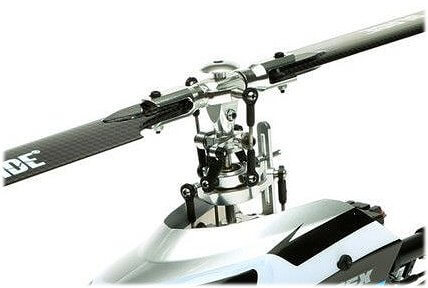
Above: a modern rotor head on a flybarless rc heli.
Flybarless rc helicopters are now the industry standard for intermediate to advanced models, and the mechanical flybar has largely been condemned to the history books forever.
The most important thing to remember when flying any kind of rc helicopter is safety. Even the soft plastic blades of a cheap 2-channel heli can do a lot of damage, and hurt. The carbon fiber blades of a large 600-size CP heli can be lethal.
It goes without saying that understanding how the primary rc helicopter controls influence the helicopter itself is of paramount importance, if you're to learn to fly your heli safely, properly and with confidence.
RC Helicopter Controls Glossary
Listed below are some of the more common terms that you'll need to know to get a better understanding of rc helicopter controls...
- Angle of Attack - the angle of the rotating rotor blades in relation to the air flowing over them, as viewed from the end of the blade.
- Coaxial - a type of helicopter that has two sets of main rotors, one mounted above the other, and no tail rotor.
- Collective pitch control - all main rotor blades are moved to the same pitch angle at the same time, thus increasing or decreasing the amount of lift evenly throughout the rotor disc.
- Cyclic pitch control - the angle of the rotor disc is changed to 'unbalance' the lift within the disc. As a result, the helicopter leans to the side that is experiencing less lift.
- Downwash - air that is forced downwards by the spinning main rotor blades.
- Flybar - short bar perpendicular to the main rotor blades, with small paddles at each end. Connected to the swash plate, the flybar tilt/twist influences the angle of attack of the rotor disc.
- Flybarless (FBL) - electronic 3-axis stabilisation technology that negates the need for a physical mechanical flybar.
- Ground Effect - when the heli is flying/hovering close to the ground and is effected by the downwash bouncing back off the ground, causing it to "skate" on a cushion of air.
- Gyro - a small electronic microprocessor-controlled device that makes minute and rapid adjustments to the tail rotor speed/blade pitch, to dampen out any unwanted yaw. Also now used on the pitch and roll axis in flybarless systems.
- Head speed - the speed in Revolutions per Minute (RPM) of the rotor head/blades.
- Main rotor - the horizontally mounted blades above the fuselage.
- Pitch angle - the angle of the rotor blades in relation to the horizontal, when viewed end-on.
- Rotor disc - the imaginary horizontal circle above the helicopter created by the spinning rotor blades.
- Rotor head - the central assembly from which the main blades extend.
- RX/ESC/Mixer - an rc receiver-looking component that incorporates the Rx, gyro, electronic speed control and pitch mixing capabilities into one unit.
- Swashplate - found at the base of the rotor head, it tilts in any direction to control the cyclic pitch of the rotor disc and moves up and down for collective control.
- Tail rotor - the vertically mounted blade at the very rear of the helicopter.
- Tail boom - the horizontal shaft that runs outwards from the main frame of the heli, to support the tail rotor assembly.
- Torque - a natural reaction to any spinning object. Spinning main rotor blades create torque, which forces the helicopter fuselage to spin round in the opposite direction to the blades.
- Yaw - the rotational movement of the helicopter about its vertical axis, controlled by the tail rotor.
Want to know some general rc flying terms? Try the rc flying glossary.
Related Pages


All of this and much more is covered in our Beginner’s Guide 👇
The Beginner’s Guide To Flying RC Airplanes is a 139-page, easy-to-read e-book written for complete newcomers. It explains exactly what to buy, where to fly, and how to avoid costly mistakes.
📖 Start reading now