

Basic RC Airplane Aerobatics - Beginner Stunts
Once you've learned to fly your rc plane confidently, it's time to step it up a notch and learn some basic aerobatics!
Flying aerobatic maneuvers is great fun and all part of the hobby, but you need to start off slowly and not try things that are too complicated to begin with. It's so important to always fly within your abilities, and progress steadily.
If you try and run before you can walk, as the expression goes, bad things will inevitably happen.
This page will ease you in to performing some simple stunts with your rc airplane, with the most basic maneuvers being the:
Important Points to remember...
1. When flying rc aerobatics of any kind, you need to fly responsibly especially if you're flying in a public place and there are other people around.
2. Choose your flying site carefully - rc airplane aerobatics usually require more airspace than normal flying, so make sure that the area is plenty big enough with no trees, posts or pylons etc.
3. Altitude is very important with most maneuvers. Always give yourself as much space as possible between your airplane and the ground. This way, if you do encounter difficulties, you stand a much better chance of not joining these guys.
"Fly two mistakes high" is an old saying in the radio control flying world, and one worth remembering. When you're learning, make it three mistakes high!
4. Always fly a safe distance away from yourself but not so far away that you can't see what your airplane is doing i.e. whether it's up the right way or not. Disorientation is one of the biggest killers of rc airplanes and it's easy to become confused about the plane's position and attitude in the sky when you are performing aerobatics.
5. The type of plane will play a large part in how easily you can fly most aerobatic maneuvers. RC aerobatic airplanes are designed for the job, and if your only plane at the moment is an ultra-stable high wing trainer then you will struggle to fly many maneuvers well, especially if your plane has only rudder and no ailerons.
6. One final important point; the majority of rc airplane aerobatics are performed in to wind i.e. you fly the airplane directly in to the wind when starting the aerobatic maneuver. This gives maximum lift and airflow over the control surfaces.
Your First Basic RC Airplane Aerobatic Maneuvers
1. The Inside Loop:
Arguably the easiest of all aerobatics to fly and any rc airplane with elevators and sufficient power is capable of looping.
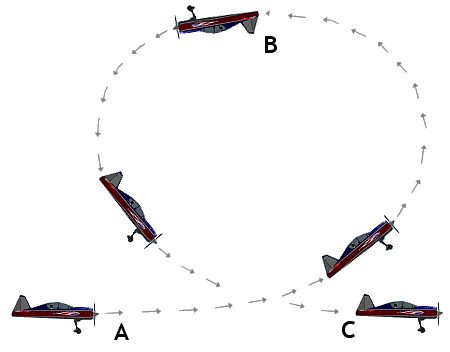
How to fly it: Start by flying straight and level in to wind, no lower than, say, 50ft/15m high.
Apply full power and, at point A in the picture above, pull back on the elevator stick to start a climb - not too suddenly, be gentle but definite. Keep the power on, your plane will go into a vertical climb.
Let it keep going until it starts to roll over onto its back - point B in the picture. At this point, close the throttle and keep holding the elevator stick back, adjusting it as necessary to maintain a tidy circular path. You might also need to use ailerons/rudder to keep the path of the loop as vertical as possible, as some planes have a tendency to try and roll out of a loop.
At point C in the picture, level out the airplane by returning elevator to neutral and increase power to exit the loop, flying straight and level again in to wind.
Below is the inside loop on video, including close-ups of the Tx stick inputs and the airplane's response.
Don't be fooled in to thinking that your plane will perform the perfect loop first time, just because it's an easy maneuver. In many cases you will need to fly the plane round the loop, rather than just yank back on the elevator and hope for the best! A perfect loop will be a vertical circle with no sideways deviations.
2. The Outside Loop:
The outside loop is a loop but with the airplane inverted i.e. the top of the plane faces outwards throughout the loop.
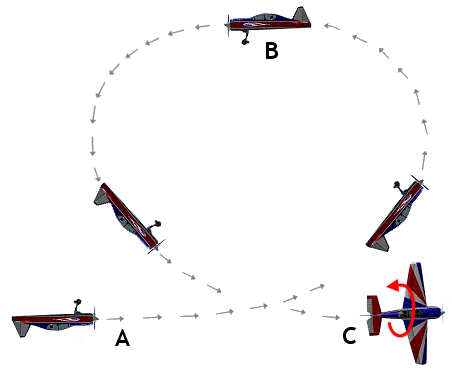
How to fly it: Your airplane must be inverted (i.e. rolled through 180 degrees) at the start of the loop (point 'A' in the picture). The danger here is to remember to use down elevator to get the airplane to climb. Accidentally applying up elevator at this point will send the airplane crashing in to the ground.
Keep holding in down elevator and let the airplane do a full loop, using ailerons and/or rudder to keep it straight. At the top of the outside loop (point 'B'), your airplane will be right side up. Reduce power and continue the loop back down towards the ground and at point 'C' roll through 180 degrees to bring the airplane right side up to exit the maneuver.
Below is the outside loop on video, including close-ups of the Tx stick inputs and the airplane's response.
Note: An outside loop can also be started from the top (point B in the above picture), and in this case is called a Bunt. Do it by flying straight and level at a good altitude and applying and holding in down elevator all the way round the loop, using rudder/ailerons to maintain the vertical. You need to reduce power at the start of the dive until the bottom, then increase to full power to complete the second half of the loop.
Practising a bunt takes nerves - you have to commit to flying the plane all the way round, and not chickening out before it reaches the inverted stage!
3. The Roll:
The roll requires ailerons but if your airplane only has rudder then you might be able to pull off a larger, somewhat untidier 'barrel roll'. A roll with ailerons is a very smooth maneuver and not too difficult to fly.
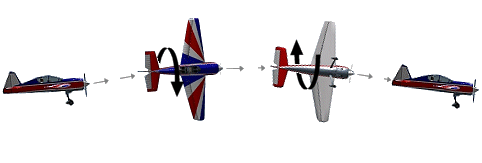
How to fly it: Same start as the inside loop; fly straight and level on at least half throttle, in to wind. To begin a roll, apply a very small amount of up elevator and left or right aileron a split second afterwards. No need for full power this time, keep the throttle stick where it is throughout the roll. If you are using rudder alone you'll need to apply much more up elevator and put the plane in to a small climb before rolling.
As you apply elevator and aileron, the airplane will start to roll about its longitudinal axis. Keep the aileron stick in the same position but you will probably have to adjust the elevator to keep the roll tidy. As the plane inverts, release elevator and apply a tiny amount of down elevator when the airplane is fully inverted, this will prevent any loss of altitude during the roll (generally speaking...).
Once the airplane is right-side up again, return the sticks to neutral and resume straight and level flying.
Below is the roll on video, including close-ups of the Tx stick inputs and the airplane's response.
4. The Stall Turn:
The stall turn, also called a Hammerhead Turn, makes use of the airplane's rudder and is a relatively simple maneuver to perform.
The aim of the stall turn is to perform a vertical climb, reduce power at the top to quickly stop the climb, while simultaneously applying full rudder to rotate the plane through 180° about its CG position, or thereabouts.
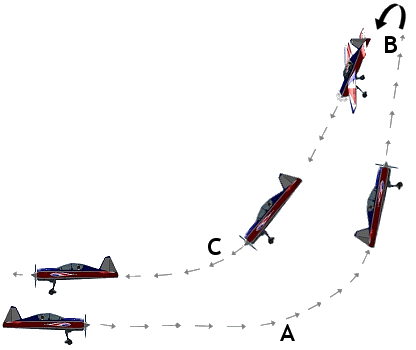
How to fly it: As before, begin with a straight and level flight path. At point A in the picture above, apply full power and up elevator, putting the airplane in to a vertical climb. Adjust the rudder and elevator as necessary to maintain the climb as vertically and as straight as possible, without going into the beginnings of a loop i.e. don't keep holding in up elevator.
Let it climb for a few seconds (depending on how much power you have to hand*) and then, at point B, reduce throttle** and - here's the important part - apply full rudder to the left or right. If the airplane doesn't look like it's going to turn neatly, give the throttle a small blip to get some prop wash (air movement) over the rudder.
Once the plane has spun round through 180° and is facing the ground, return the rudder to neutral and let the airplane go naturally into a brief vertical dive for a second or so. Then, at point C, apply up elevator to pull out of the dive and then power, to resume straight and level flying.
*How long you climb for will largely be determined by how much power you have - less powerful planes will just run out of steam after starting to climb, whereas planes with unlimited power can keep on going - in which case, limit your climb to no more than three or four seconds.
**How much you reduce throttle at the top of the climb depends on a few things, not least of which is the type of plane and size of rudder. You shouldn't cut the motor right back, because you need some prop wash (i.e. airflow) over the rudder to facilitate the turn. Only experience and practice will tell you how much power you need at the turn.
Below is the stall turn on video, including close-ups of the Tx stick inputs and the airplane's response.
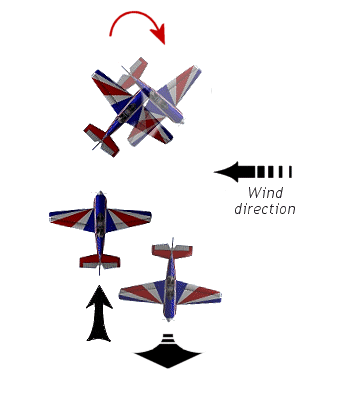
If you want you can use the wind direction to help you perform the stall turn by flying crosswind. Fly at 90 degrees to the wind and turn the airplane in to the wind at the top of the climb. The wind on the fin pushes the plane round for the perfect maneuver!
The picture below shows this:
So there you have the most basic rc airplane aerobatics. Take your time and practice them in safety, then move on to the more advanced maneuvers (page links listed below).
Remember that the design and type of your plane will greatly effect how well you can execute any maneuver, so don't get disheartened if your plane isn't suited to every maneuver shown above - just select the ones that you can try.
Don't expect to be able to do much with a basic 3-channel high wing trainer, but once you move on to a 4-channel mid or low wing airplane with ailerons then the fun really starts!
Practising RC Plane Aerobatics in Safety
By far the safest way to practice these aerobatics is on an rc flight simulator. You can read more about them through that link, or click any of the product suggestions below to go shopping for sims...
You might also like to read about...
 Cuban 8 RC airplane aerobatics.
All of this and much more is covered in our Beginner’s Guide 👇
The Beginner’s Guide To Flying RC Airplanes is a 139-page, easy-to-read e-book written for complete newcomers. It explains exactly what to buy, where to fly, and how to avoid costly mistakes.
📖 Start reading now