

RC Powered Gliders Overview
For a gentler introduction to radio control flying, rc powered gliders are a great option; their stable and forgiving flight characteristics make them good for beginners to the hobby.
But what is a powered glider?
Also called a motor glider or e-soarer, this aircraft type is essentially a standard glider design with a motor added. The motor can be mounted in the nose, behind the wing on a fixed pod, or on a 'pop up/fold away' support that folds down into the fuselage when not in use, on top of or just behind the wing.
Nose (and some pod) mounted motors turn a folding propeller, and this is key to reducing drag when power is off.
Powered Glider Examples
For beginners to the hobby, something like E-flite's™ Conscendo Evolution® is an excellent introduction to powered gliders.
With its SAFE™ technology, it's been designed to make learning to fly this aircraft type as easy as possible.
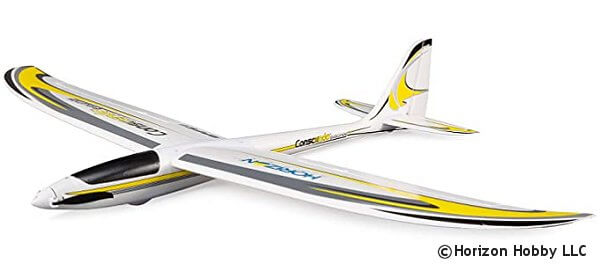
SAFE technology gives you two levels of electronic stabilization, or can be deactivated completely. These options, coupled with the inherent stability of the glider, really give the beginner rc pilot a fighting chance of having successful first flights!
And from a personal point of view, I think the Conscendo is one of the nicest looking powered gliders currently around.
Moving up in terms of control complexity, the ParkZone Radian Pro, shown below, has been a firm favourite for years. I've had one myself and can certainly recommend them.

The Radian Pro has a two meter wingspan, making it a good size powered glider capable of riding the thermals on a warm day. An rc powered glider like this will reward you with very long flight times, with careful use of the power and good soaring skills!
This glider isn't particularly a complete beginner's glider, since it has 'full house' wing features, but it is an excellent powered glider for intermediate pilots.
At my soaring club competitions it has, on occasion, outperformed much more expensive rc powered gliders!
Of course, rcpowered gliders don't have to be of foam construction. There's a huge range of built-up aircraft as well as kits to build yourself.
As you climb the price ladder, so construction turns towards glass fiber and carbon fiber, even kevlar. E-flite's Mystique, shown below, is a nice example of a powered glider featuring a glass fiber fuselage and traditionally built-up wings.

I've flown a Mystique several times and it really is a nice glider to spend a sunny summer's afternoon thermal hunting with!
Folding Propellers
Radio controlled powered gliders are equipped with a folding propeller to reduce drag when the motor is not in use.
The blades of the prop are hinged at the root, and when the motor is running the blades are in their normal forward position, thus pulling the glider through the air.
When the motor is shut off, the air over the blades pushes them back so that they lie flat against the side of the fuselage, drastically reducing any unwanted drag while the glider is gliding.
Turn the power on again, and the blades flick out to generate thrust once more.

Above: the folding propeller blades of an rc powered glider at work: left, the blades in their normal positions when the motor is on, powering the glider through the air. Right, with the motor off the forward motion of the glider through the air pushes the blades back to lie flat against the nose, thus reducing drag.
Sometimes folding propeller blades might refuse to fold back, and the trick here is to use an ESC with a brake function. If the blades don't fold back as they should, the prop will 'windmill' - turn freely in the air - and this creates a lot of drag, and hence the glide rate of the aircraft will be reduced.
An ESC brake will electronically stop the motor from turning, with the Tx stick fully down, and this will allow the prop blades to fold back.
Flying an RC Powered Glider
RC powered gliders are, more often than not, very gentle birds. They have stable and forgiving flight characteristics, giving you plenty of time to react.
One thing that makes them so appealing is flight duration. On a good day, flights of an hour might not be uncommon.
You hand launch the glider under power, and use the motor to climb to a good altitude. Once reached, turn the motor off and let the soaring capabilities take over.
With good thermals around, the glider will stay aloft for as long as your soaring skills allow. When you've lost altitude, simply turn the motor back on and commence another climb. Repeating this process means that the motor battery pack won't be drained quickly, and your flight will last and last, so long as you can continue to find any lift that's around.
If there are a few of you flying together, why not hold a simple duration competition?
All you need to do is launch at the same time and to the same altitude (for example, have a 30-second motor run), switch off the motor and stay up for as long as you can - the last one down wins.
It's a great way of enjoying some light-hearted competitive radio control flying with your friends, and it improves your flying skills too. And if you want to throw some extra points into the game, make a simple spot landing rule!
RC 'Hotliners'
The so-called 'hotliners' are essentially rc powered gliders with extra muscle!
The configuration is the same but the aircraft are sleeker and have more powerful motors. As a result, they fly a lot faster, as the video below shows...
Hotliners aren't for beginners because of their speed - you need good reactions and co-ordination, both which take time to develop when learning to fly a radio control plane.
But hotlines, and even 'warmliners' are great fun to throw around the sky, and also benefit from longer flight times with careful use of power.
Conventional RC powered gliders are, in my opinion, one of the best introductions to powered rc flight available. And they give you the best of both worlds; power when you need it, a glider when you don't!
If you're looking for some relaxing and easy radio control flying, a powered glider is without doubt the answer, and in my opinion is a great option for the beginner rc pilot.
Related Pages

All of this and much more is covered in our Beginner’s Guide 👇
The Beginner’s Guide To Flying RC Airplanes is a 139-page, easy-to-read e-book written for complete newcomers. It explains exactly what to buy, where to fly, and how to avoid costly mistakes.
📖 Start reading now