

RC Plane Watts Per Pound Guide: How Much Power Do You Need?
Welcome to the ultimate guide on the Watts per pound rule for RC planes. If you're venturing into the exciting world of electric RC airplanes, whether you are building an Almost Ready To Fly (ARTF) kit or designing a custom power setup from scratch, figuring out exactly how much power your aircraft needs can quickly feel overwhelming. Too little power, and your plane will struggle to stay airborne; too much, and you risk burning out your electronics or adding unnecessary weight.
More of a 'rule of thumb' than a strict scientific law, the RC airplane watts per pound rule is the golden formula used by aeromodellers worldwide to determine adequate power output for any given electric flight setup. In this beginner-friendly guide, we will explain exactly what this rule means, how to calculate it for your specific model, and provide a handy guideline chart so you can achieve the exact performance you desire—from slow, lazy park flyers to cloud-punching 3D aerobats.
It's generally accepted that any plane with less than 50 Watts per pound (W/lb) is going to struggle unless it has a very low wing loading. At the other end of the scale, a powertrain setup that's delivering 200 or more Watts per pound is going to have pretty much unlimited ballistic performance! Let's dive in and demystify your electric power setup.
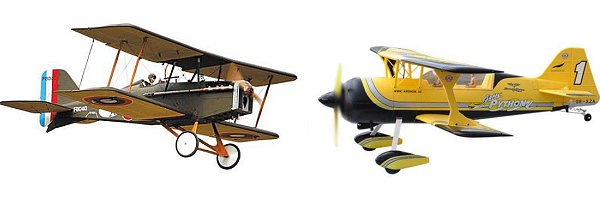
Above: A WWI SE5A, left, and a modern Pitts Python.
Both biplanes, but at opposite ends of the Watts Per Pound scale!
General Power Guidelines
Here are some Watts per pound values that should put you in the right ballpark for your particular plane...
- Less than 50 W/lb - very lightweight / low wing loading slow flyer.
- 50 to 80 W/lb - light powered gliders, basic park flyers and RC trainer airplanes, classic biplanes and vintage ('Old Timer') type planes.
- 80 to 120 W/lb - general sport flying and basic/intermediate aerobatics. Many scale (eg RC warbirds) planes suit this power band.
- 120 to 180 W/lb - more serious aerobatics, pattern flying, 3D and scale EDF jets.
- 180 to 200+ W/lb - faster jets and anything that requires cloud-punching power!
By working around those categories you should be able to decide how much power your rc airplane needs to perform well. The categories aren't meant to be exact, but they are very good starting points.
How to Calculate Watts Per Pound for Your RC Plane
Before you can apply the rule, you actually need to know how to calculate it! Fortunately, you don't need a degree in mathematics—just a few simple steps.
Step 1: Find the All Up Weight (AUW)
Remember that for the Watts per pound rule to be effective, you need to weigh the plane in its completely 'flight ready' state. This means the motor, ESC, servos, receiver, and crucially, the flight battery pack must all be in the plane. Use a reliable digital scale to get an accurate reading in pounds (lbs). If your scale measures in ounces, simply divide the total ounces by 16 to get the weight in pounds.
Step 2: Determine the Motor's Total Watts
Most brushless motor manufacturers will list the maximum continuous Watts in the motor's specifications. If you are aiming for a sport aerobatic plane that weighs exactly 2 lbs, and the chart above recommends 100 W/lb, you know you will need a motor capable of delivering at least 200 Watts continuously.
Step 3: Do the Math
Simply divide the total Watts your motor produces by the AUW of your plane.
Example: A 300-Watt motor on a 3 lb plane = 100 Watts per pound. Perfect for a sport flyer!
What's a Watt?
A Watt is the correct unit to measure electrical power and Watts are calculated by multiplying the voltage (V) by current in amps, for which the proper symbol is 'I' but you'll also likely see it written as 'A'.
So, VxI=W or VxA=W.
If you're making the switch from gas and are looking for the IC (internal combustion) equivalent, 1hp (horsepower) is equal to 746W.
Using a Watt Meter
The calculations are great for theory, but the only sure-fire way to determine how much power your particular setup is actually producing in the real world is to use a Watt meter.
This useful little tool is actually essential if you do want to start experimenting with different EP setups. It connects between your Li-Po flight pack and your ESC, and will give you live readings of Amps, Volts, and Watts throughout the power range. Simply connect it up, safely restrain your plane, power up the motor, and read off how many Watts are being produced at full throttle. You can pick up a high-quality RC digital Watt meter here.
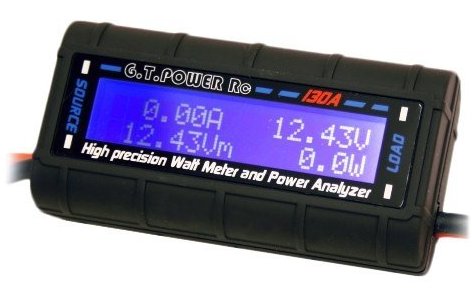
Above: an RC Watt meter is essential once you get in to
doing your own electric power setups.
Watt meters take all the guesswork out of electric plane powertrain setups, and for the little money they cost will give you a massive amount of peace of mind.
Common Mistakes When Planning Your Power Setup
When putting together a new powertrain, it's easy to make a few classic beginner errors. Avoid these common pitfalls to keep your plane flying beautifully:
- Over-propping: Realistically it all comes down to experimentation as far as actual performance goes. Once you've decided on a suitable motor, you will play around with propeller selection. Increasing prop diameter and pitch will draw more Watts, but be careful! Over-propping an electric RC airplane is one sure way to burn out the ESC because the motor is forced to draw more current than the ESC can handle. Always test new props with your Watt meter!
- Weighing the plane without the battery: As mentioned earlier, calculating your Watts per pound based on the empty airframe weight will give you completely inaccurate numbers. Li-Po batteries are heavy—always use the true All Up Weight (AUW).
- Assuming more power is always better: While it's tempting to strap a 600-Watt motor to a lightweight trainer, having 200+ W/lb on a plane designed for gentle flying will make it twitchy, overly sensitive, and unnecessarily heavy due to the larger motor and battery required. Stick to the guidelines for the type of flying you intend to do.
Weight or Wing Loading?
It's worth noting that although the Watts per pound rule works on the actual flying weight of the airplane (AUW), the more realistic and accurate reference to a plane's performance in relation to its flying weight is called the wing loading.
Wing loading is a value expressed (for model planes) in ounces per square foot (Oz/ft²) or grams per square decimeter (g/dm²), and is the flying weight of the plane divided by the total wing area.
The larger the wing area and lighter the plane, then the lower the wing loading will be and vice versa.
A lower wing loading means slower take off capability and better flying performance in many ways. But for the purpose of calculating power requirements for your model, in terms of the Watts per pound rule, work with the actual weight of it and don't worry about wing area or loading.
If you're a complete beginner to the hobby with your first RTF rc plane, then you won't need to worry about Watts per pound or wing loadings just yet. The manufacturer has already done the math for you! But as you get more in to the hobby and start building ARF kits, do take the time to understand and know how to use these important calculations.
What is a good Watts per pound ratio for a beginner RC plane?
For a beginner flying a high-wing trainer, you should aim for the 50 to 80 Watts per pound range. This provides plenty of power to climb safely and recover from mistakes, without making the plane too aggressive or difficult to handle.
Does the Watts per pound rule apply to gas RC planes?
No, the Watts per pound rule is specifically for electric power (EP) setups. For gas or glow plug engines, aeromodellers rely on engine displacement sizes (like a .40 or .60 size engine) matched to the wingspan and weight of the aircraft. You can read more about model airplane engines here.
Why is my motor getting so hot if my Watts per pound ratio is correct?
If your ratio is correct but your motor or ESC is overheating, you are almost certainly over-propped. A propeller that is too large or has too steep a pitch will force the motor to draw excessive current trying to turn it. Step down your prop size and test again with your Watt meter.
You might also like to read about...
 RC airplane propeller size guide.
All of this and much more is covered in our Beginner’s Guide 👇
The Beginner’s Guide To Flying RC Airplanes is a 139-page, easy-to-read e-book written for complete newcomers. It explains exactly what to buy, where to fly, and how to avoid costly mistakes.
📖 Start reading now