

RC Model Jet Engine Guide: How RC Turbines Work
Nothing beats the sound, smell, and blistering speed of a true RC model jet engine. If you want to add the ultimate touch of realism to your radio control flying experience, miniature gas turbines are without a doubt the pinnacle of the hobby. But how exactly does an RC jet turbine work, and what does it take to operate one safely?
Make no mistake, flying turbine RC jets is highly demanding and definitely not for the novice pilot. It requires countless hours of flying experience and a very healthy budget. These miniature jet engines—along with the advanced airframes, complex radio gear, and specialized fuel setups—are a serious investment. However, for those willing to take the leap and put in the practice, piloting a kerosene-burning, fully functional gas turbine is one of the most rewarding thrills in aeromodelling.
In this guide, we will explore the inner workings of an RC gas turbine, how they compare to electric ducted fans (EDFs), the specific fuel and oil requirements, and the actual mechanics of how these incredible micro turbine engines generate so much thrust.
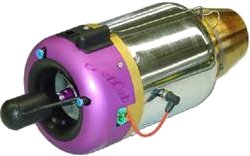 Shown right is a JetCat model turbine, one of the first and more popular commercially produced model jet engines readily available. Wren, from the UK, is another favourite model jet engine manufacturer with an excellent reputation although sadly the company was liquidated.
Here's a video of a JetCat P80 being bench run:
Pre-turbine Power Options
Before model jet engines appeared on the scene, rc jets always lacked the authenticity of having a true gas turbine. Previously, radio control aircraft types designed as jets had to be powered by either an engine with a propeller (thus spoiling the look of the aircraft) or ducted fan units.
 A ducted fan unit (shown right), is mounted inside the jet's fuselage. This at least means there is no propeller to ruin the look of the jet, but early (pre-electric power) glow plug powered ducted fans were very noisy, giving a very unrealistic high pitch whining sound.
Nowadays, if you fly electric RC airplanes, electric powered fan units (EDFs) are commonplace. While the noise isn't perfectly realistic, it is significantly better than an IC fan unit.
More recently, EDF impellers have increased from the typical 5 or 6 blades to 11 or 12. This results in more air movement through the fan being heard, rather than motor noise, in turn resulting in a much more convincing "whoosh" sound. EDFs have made flying a model rc jet much more accessible within the hobby and serve as the perfect stepping stone before moving up to true turbines.
Pulse jets were/are another option but these more resemble rocket motors rather than jet engines. Pulse jet motors are long slender motors that, because of their size and shape, typically need to be fixed to the outside of the fuselage.
A pulse jet runs at full throttle for a short time, the fuel (usually gasoline) being pulsed through inlet valves. An even more unrealistic sound than an EDF, a pulse jet motor kind of sounds like an impressively drawn-out fart!  .
.
Once the fuel is spent, the motor cuts and the pilot glides the jet back to land. Fun maybe, but not particularly realistic!
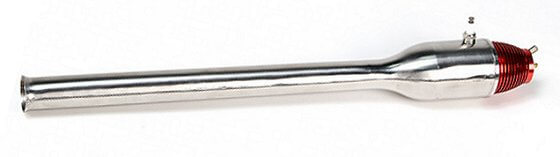
Above: an RC pulse jet motor.
Model Jet Engine Operation
The most common type of model gas turbine is the centrifugal flow turbine as opposed to the lengthier axial flow turbine.
The big difference between centrifugal and axial flow turbines is in the stage of air compression.
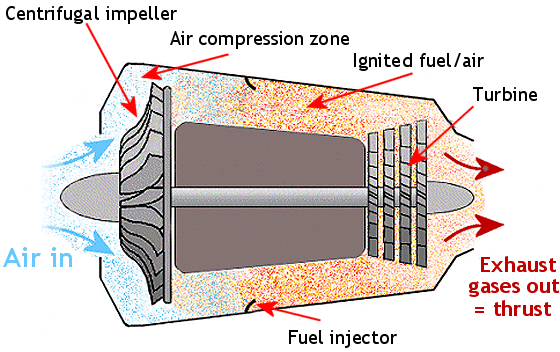
In a centrifugal flow unit, air is sucked into the front intake by the spinning impeller and immediately flows over the compressor (stator).
The stator greatly compresses the incoming air before it passes into the combustion chamber. This intense compression increases the pressure and hence temperature of the air, making it more effective when it mixes with the fuel.
Alternatively a centrifugal impeller is used whereby this single component does the job of intake impeller and compressor stator, by drawing in the air and throwing it outwards at great force to compress it against the inside of the can.
The kerosene based fuel, commonly called Jet A1, is introduced into the combustion chamber as a very fine mist and so mixes easily with the now highly compressed air. This fuel/air mixture is then ignited by a small glow plug.
As the fuel/air mixture ignites and explodes within the chamber, the coned shape of the chamber and the incoming flow of new air forces the mixture rearwards towards the turbine. The rapid outward flow of the gases spins the rear turbine which in turn spins the impeller at the front of the jet engine (both components are connected by a central shaft), and so continuing the process.
The gases (exhaust) finally get squeezed through the narrowing jet pipe at the very rear of the engine, exiting at great speed and pressure thus generating the high levels of thrust associated with jet turbines.
The simplified drawing below shows the basic principle of a centrifugal flow model jet engine:
Below is a cool video of what goes on inside a model jet engine...
Turbine Fuel and Oil Requirements
Unlike a standard glow plug engine found on gas RC airplanes, an RC model jet engine doesn't run on nitro. Instead, these miniature powerhouses run on real aviation fuel—typically Jet A1, Kerosene, or sometimes diesel.
Because the internal bearings of a gas turbine spin at incredibly high speeds (often exceeding 100,000 RPM!), they require specialized and constant lubrication. Pilots must mix their jet fuel with a high-quality synthetic turbine oil (usually around a 4% to 5% oil mix) to keep the engine running smoothly, prevent overheating, and avoid catastrophic bearing failure.
Engine Start-Up
Model jet engines need to be initially spun up without burning any fuel, just as full size ones do. Only when the turbine has reached the necessary revolutions per minute (RPM) can the fuel be introduced into the chamber and the engine can begin to operate normally.
This initial part of the start-up sequence can be done by blowing compressed air into the front of the engine to spin the compressor, or an external high-RPM electric starter can be used, similar to those used for starting standard rc airplane engines.
A third and increasingly common option is an integrated small electric starter motor. This of course gives you the auto-start option, which is true to a real gas turbine.
Safety and Common Turbine Mistakes
Make no mistake, operating a miniature jet engine comes with real risks. The exhaust temperatures are extremely high, and the suction at the intake is incredibly powerful. A common mistake beginners make when testing their first turbine is failing to protect the intake from debris.
Even a tiny pebble, loose screw, or blade of grass sucked into the compressor can destroy the turbine blades instantly. Fitting a protective FOD (Foreign Object Damage) screen over the intake is a cheap and highly recommended insurance policy for your expensive engine.
Another serious hazard is the dreaded "hot start." This happens when excess fuel pools in the turbine during a failed start attempt and ignites, causing a large flare of flames to shoot out the exhaust. Because of this, it is absolutely mandatory to always have a CO2 fire extinguisher sitting within arm's reach whenever you are starting or bench-testing your jet.
Below is another video of model jet engines in action, this time in a superb radio controlled F-14 Tomcat:
Model Jet Engine Reading
The actual technicalities of model jet engines for radio control use are obviously more complex than this page outlines, but aside from the wealth of information available on the internet there are some good books on the subject, worth considering:
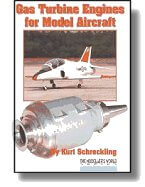
Gas Turbine Engines for Model Aircraft by Kurt Schreckling and Keith Thomas.
"I found the book easy to follow and I've found that Kurt Schreckling and Keith Thomas have made an excellent job of bringing the complexities of the gas turbine to a level the average person can understand and learn from..." (Amazon customer review).
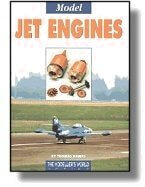
Model Jet Engines by Thomas Kamps and Keith Thomas.
"Until I saw this book I didn't believe it would be possible for an amateur to build a jet engine, capable of running at 100,000 rpm . Kamps book explains clearly how, with a reasonably well equipped workshop, a model engineer can build an efficient working jet engine..." (Amazon customer review).
The very first time I saw a true rc turbine jet in action was at my local flying club field, in the early 1990s. A member of staff from a local hobby shop brought it along to our patch to demonstrate, and I was awestruck!
Sadly I've never reached the dizzy heights of radio control jet flying, but maybe one day I might achieve it. For now I'll have to settle for my EDF flying!
Common Questions About RC Model Jet Engines
How much does an RC jet engine cost?
The turbine engine alone can cost anywhere from $1,500 for a smaller entry-level unit to well over $5,000 for high-thrust professional turbines. Once you factor in the composite airframe, retractable landing gear, and specialized, high-torque radio equipment, a complete turbine jet setup is a very significant financial investment.
What fuel do RC turbines use?
Most RC gas turbines run on Jet A1 aviation fuel or Kerosene. This fuel must be carefully pre-mixed with a specific synthetic turbine oil to lubricate the high-speed ceramic bearings inside the engine.
Are RC jet engines dangerous?
They certainly can be if not handled with respect. The exhaust gases are hot enough to melt tarmac, and the compressor blades spin at over 100,000 RPM. You must always follow strict safety protocols, keep a CO2 fire extinguisher handy, and never stand directly in line with or directly behind the turbine when it is running.
EDF vs. Turbine: Which is better for beginners?
An Electric Ducted Fan (EDF) is the perfect stepping stone and the only logical choice for beginners. EDFs are significantly cheaper, much safer, require no messy flammable fuels, and are easier to maintain. You should be highly proficient at flying fast EDF jets before you even consider moving up to a true gas turbine.
You might also like to read about...


All of this and much more is covered in our Beginner’s Guide 👇
The Beginner’s Guide To Flying RC Airplanes is a 139-page, easy-to-read e-book written for complete newcomers. It explains exactly what to buy, where to fly, and how to avoid costly mistakes.
📖 Start reading now