

How to Balance an RC Plane: RC Airplane Center of Gravity Guide
Welcome to Lesson 4 of the RC Airplane World Flight School! If you've just finished putting together your new aircraft, you might be tempted to charge the battery and head straight to the field. But before you do, you must understand how to balance an RC airplane correctly.
Getting the Center of Gravity (CG) right on your RC plane is one of the most critical steps for safe and successful flying. An RC plane that is properly balanced will fly smoothly, predictably, and require very little trim. On the flip side, an incorrect CG can make your plane completely uncontrollable, potentially leading to a disastrous maiden flight.
In this guide, we'll explain exactly what longitudinal and lateral balance mean, how to check your plane's CG using your fingers or a dedicated balancing tool, and what to do if your plane is nose-heavy or tail-heavy.
 Every rc airplane has a specific CG position, it's the mean point where all gravitational forces act upon the plane, and the point where the plane balances fore-aft correctly. Technically this is called longitudinal balance.
The CG point is determined during the design stage of the plane and is typically shown on a plan as a disc split in to four quadrants, as shown to the right.
If you've built from a kit, the CG should be clearly marked on the plan but if you've bought an ARF or RTF plane then the instruction manual should give you the CG position. Typically it will be given in terms of a specific measurement (in millimeters or inches) back from either the leading edge of the wing or from the nose.
Incidentally some rc airplane manufacturers specify a range that the Center of Gravity can fall into, rather than a single point. This is not unusual, and just means the CG can be moved forwards or backwards slightly without having an adverse affect on the plane's flight characteristics.
Nose Heavy vs. Tail Heavy: What's the Difference?
Balancing a radio control plane correctly about its Center of Gravity is so important because a very badly balanced plane will, at best, be exhausting to control. There is an old saying in the aeromodelling hobby that you should always remember: "A nose-heavy plane flies poorly, but a tail-heavy plane flies once."
- Nose-Heavy (CG too far forward): The plane will naturally want to dive. You will have to constantly hold "up elevator" on the transmitter just to fly straight and level. While it makes the plane feel sluggish and heavily reduces your glide performance, it is generally stable and survivable.
- Tail-Heavy (CG too far back): This is the absolute worst-case scenario! The plane will want to pitch its nose up constantly. The elevator controls will become incredibly sensitive (twitchy), and the plane will be extremely prone to stalling and spinning out of control. It is very difficult to safely land a tail-heavy plane.
Methods of Balancing RC Airplanes
High-wing planes are the easiest to balance and if it's your first plane then this is likely to be the case, since you should have bought a high wing trainer to learn on! (Learn about beginner rc planes.).
Also, a high-wing trainer will more than likely have a parallel wing chord (a straight wing), which the following method applies to. Tapered and delta wing shapes need to be treated differently, but it's (hopefully) unlikely that your first rc plane will have anything other than a standard parallel wing.
So, then, the first thing you need to do is identify the correct Center of Gravity position according to the plan or manual. As a very general rule of thumb the CG will be about one-quarter to one-third (25% to 30%) of the wing chord (width) back from the leading edge of the wing. The main wing spar, if there is one, often lies in this general area.
Again, this position is only a generalisation and in reality a CG point can be found anywhere from, say, 25% to 50% of the wing chord back from the leading edge. A CG point outside of that range is rare, but not impossible.
A quick and easy method of balancing rc planes, if you don't have a special plane balancing tool, is the finger method:
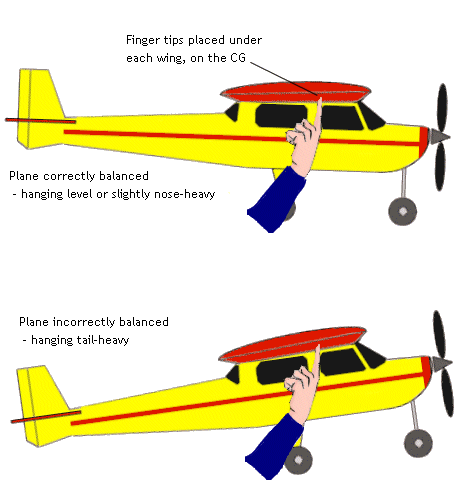
- Place the tips of your index or middle fingers under each wing, exactly on the CG point (i.e. the specified distance back from the leading edge of the wing or nose of the plane) and a couple of inches out from the fuselage sides. Gently lift the plane up so it is clear of any surface and let it rest freely on your fingertips.
By the way, your plane must be 'flight ready' when you balance it i.e. flight battery pack in place or fuel tank empty. With the latter scenario, an IC plane is best balanced with an empty fuel tank otherwise the plane will become tail heavy as the tank empties during the flight. It's far better to start a flight slightly nose heavy than be landing slightly tail heavy! - A correctly balancing rc airplane, sitting on your fingertips, will either be perfectly level or have the nose pointing slightly downwards. If the tail points downwards then the plane is tail heavy and you absolutely must do something about that before taking it to the field.
If the balance does need to be adjusted to get the correct Center of Gravity, the first thing to do is try moving the battery pack further forward or backward inside the plane. By doing this you are adjusting the balance without adding extra 'dead' weight in the form of ballast.
In an electric plane this will be the main flight pack that you want to try and move, in an IC plane it will be the receiver battery pack.
Obviously you need to move the component in accordance with how the plane hangs: if it's tail heavy then move the component forward and vice versa.
The battery pack is the best thing to move because it is the heaviest item and will have the greatest effect with the smallest amount of movement. Carefully try and reposition it fore or aft, carefully rechecking the balance of the plane after you've moved it.
Once you're happy with the new balance, make sure that the battery pack is completely secure (using strong velcro straps) and won't move from its new position. If it moves backward during a flight, the CG moves too—and that's a quick recipe for a crash!
Ballasting Up (Adding Weight)
If you can't reposition anything, which is sometimes the case in an RTF plane where the battery compartment is fixed, you might have to add ballast to either the nose or the tail of the plane to correct the CG. You need to remember, though, that ballast adds dead weight to a plane which is rarely good - the lighter an rc plane is, the better it performs (generally speaking, although there are exceptions). So if you do need to add ballast to correct the CG, add as little as possible.
Add the ballast as far forward or as far back as you possibly can on the plane. By doing this, the leverage effect means the ballast will have the most effect on the Center of Gravity, allowing you to use less weight. Add only enough to make your plane balance correctly, no more.
Suitable ballast can be modelling clay or fishing split shots, for example. However, the easiest and cleanest option is to buy self-adhesive RC lead balancing weights. These come in small pre-measured squares (like 1/4 oz or 5g blocks) that easily stick inside the cowl or under the tail.
Whatever ballast you do add, make sure it is completely secure to the plane and won't drop off in flight!
RC Plane Balancing Tool
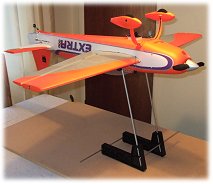 The finger-method described above is a tried and trusted, albeit fundamental, way of balancing an rc plane. But for a much more accurate method you can purchase a dedicated CG balancer tool.
Using an RC Airplane CG Balancer Machine is highly recommended as you get deeper into the hobby. Such a tool removes the guesswork of your fingers and gives you millimeter-precision balancing. In the image to the right, you can see a commercial balancer being used to perfectly balance my Extra 300.
You can also make a balancing tool - something as simple as a heavy block of wood with two upright wooden dowels, approximately 10" long, will do the job for smaller planes. Simply drill holes in the block and push the dowels into them, ensuring a tight fit. You can glue pencil erasers to the top of the dowels so they don't puncture your wing.
So long as the plane can balance on two points, one under each wing, then you have a balancing tool.
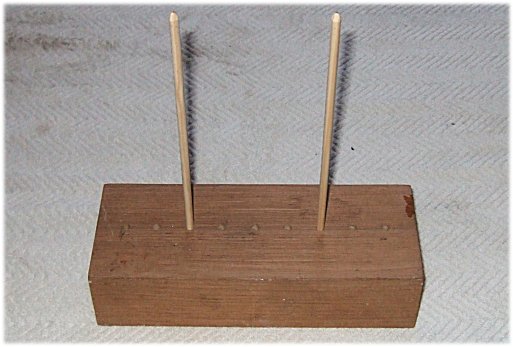
Above: a homemade rc airplane balancing tool. Simple but effective!
Incidentally, balancing rc planes on fingers is frowned upon by some precision aerobatic aeromodellers, since it isn't 100% accurate, but the method has served me (and countless other sport flyers) well when I haven't had a proper balancer. Also, a quick CG check can be easily done at the field on fingers if you swap out to a larger or smaller battery.
Roll Balancing RC Airplanes (Lateral Balance)
Roll, or lateral balance to give it its proper name, is an often overlooked task and isn't as critical as longitudinal balance. But an rc plane that has one side (one wing) heavier than the other will have a tendency to naturally roll and turn to the heavier side, making your life on the sticks a bit harder.
Also, a heavier side will almost always result in that wing dropping aggressively when the plane stalls, potentially snapping the plane into an unwanted spin.
The usual cause of a plane being out of balance laterally is unequal weights of the wings (one wing half simply having denser balsa wood than the other during manufacturing).
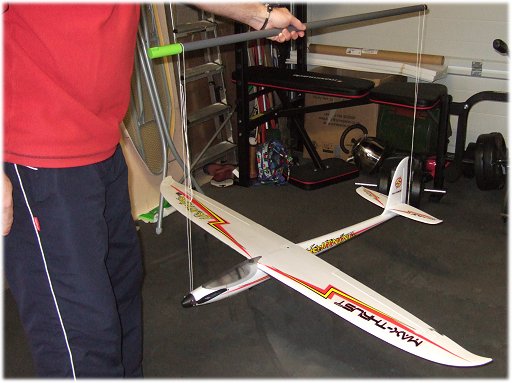
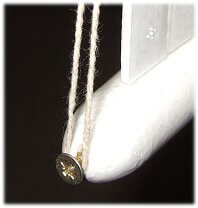 To roll balance your plane simply hang two lots of strong string from something fixed and stable (i.e. a ceiling joist), each piece being in a large loop. Put one around the propeller shaft, between the prop and the fuselage, and the other around the rear of the fuselage, as close to the tail as you can get. If possible insert a small-gauge pin or screw into the very rear of the fuselage to hook the string around, as shown right. This gives a more accurate result since the plane can hang more freely.
If you can't hang the plane from something solid, like the ceiling, use a rigid pole to hang the strings from. The photo below shows this being done:
For smaller rc planes, say about the 40" wingspan mark or less, it's quite possible to hold each piece of string in each hand:
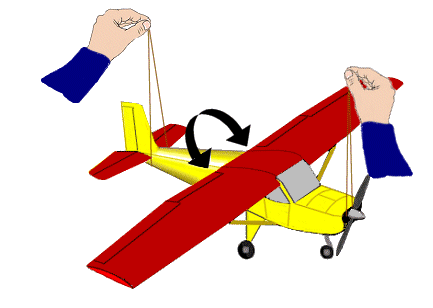
Let the plane hang freely on the string - see if it wants to roll to one side or another. If it does then you need to add some small ballast to the wingtip of the lighter (higher) side. Add only enough to make the plane hang so that both wings are perfectly level.
Taping the ballast to the wingtip is an easy temporary method, although you might want to take the trouble to set any ballast into the wingtip and cover it over with matching covering film. Bear in mind that adding larger bits of tape will actually add extra weight in addition to the ballast.
For rc airplanes with foam wings, pushing a small gauge nail or panel pin into the foam is a great way of adding any necessary weight, and it can be easily hidden with suitable paint or marker pen.
Do take a few minutes to check your roll balance as well as your CG balance. I've had several airplanes that have needed up to 10 grams in wingtip weight added, and the difference in flight characteristics is very noticeable!
So there you have it... two easy methods of balancing rc airplanes. As already mentioned, the longitudinal balance is very critical if you want to keep your plane in one piece. Lateral balance isn't so critical but is worth doing anyway to ensure smooth, straight tracking in the sky.
A correctly balanced rc airplane will always be safer and easier to fly, and won't need anywhere near as much trimming at the transmitter.
Common Questions About Balancing RC Planes
What happens if my RC plane is tail heavy?
A tail-heavy plane is extremely dangerous to fly. The plane will constantly want to pitch its nose up, and the elevator controls will become incredibly sensitive. In this state, the plane is highly prone to stalling and entering an unrecoverable spin. If your plane is tail heavy, you must add weight to the nose or move the battery forward before flying.
Is it better for an RC plane to be nose heavy or tail heavy?
It is always much better and safer for a plane to be slightly nose heavy. While a nose-heavy plane will feel slightly sluggish and require you to hold a bit of "up elevator" to fly level, it will remain stable and predictable. A tail-heavy plane is erratic and uncontrollable.
Can I balance my RC plane with the battery taken out?
No! You must balance your RC plane in its "flight ready" state, which is known as its All Up Weight (AUW). The flight battery is usually the heaviest component in an electric plane, and its position drastically alters the Center of Gravity. Always balance the plane exactly as it will be flown.
How do I find the CG if I lost my instruction manual?
If you don't have the manual for a standard straight-wing (parallel chord) airplane, a safe rule of thumb is to set the Center of Gravity at 25% to 30% of the wing's width (the chord), measuring backward from the leading edge (the front) of the wing. It's best to start at 25% to ensure the plane is slightly nose heavy for the maiden flight, then adjust backward as needed.
 Next up: Lesson 5 - Where to fly your rc airplane.
Or skip to the lesson appropriate to your current situation...
- Lesson 1: Buying your rc airplane.
- Lesson 2: Know your rc airplane.
- Lesson 3: Preparing your plane.
- Lesson 5: Where to fly.
- Lesson 6: Pre-flight checks.
- Lesson 7: Take off / hand launch.
- Lesson 8: Flying your rc airplane.
- Lesson 9: Landing your rc airplane.
All of this and much more is covered in our Beginner’s Guide 👇
The Beginner’s Guide To Flying RC Airplanes is a 139-page, easy-to-read e-book written for complete newcomers. It explains exactly what to buy, where to fly, and how to avoid costly mistakes.
📖 Start reading now