

RC Gliders & Sailplanes
RC gliders can offer the beginner a very gentle introduction to the radio control flying hobby, but can also offer the experienced rc pilot some truly exhilarating aerobatic and racing opportunities - such is the diversity of radio control gliding.
But what's the difference between the names glider and sailplane ?
Well, technically speaking a glider is any motorless aircraft capable of stable unpowered flight, even over just a short distance. For example, man's early attempts at flight were done in simple gliders, and flights were no more than a few hundred feet long.
A sailplane is simply a glider type. Sailplanes are specifically designed for sustained unpowered performance, primarily by using columns of warm air (thermals) to keep aloft. In the radio control flying hobby, both names may be used to describe a motorless aircraft.
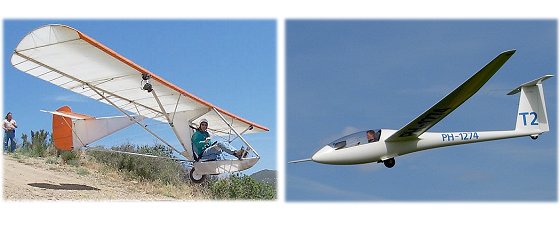
Above: full size ultralight glider (left) and a sailplane.
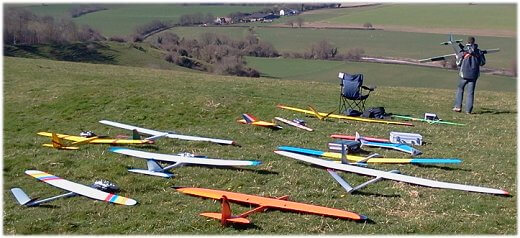
Above: an eclectic mix of RC gliders & sailplanes on my club slope.
Easy RC Flying
Simpler rc gliders are excellent for newcomers to the hobby. Most conventional beginner rc gliders are 2 or 3-channel, with control to either rudder and elevator, aileron and elevator or rudder, aileron and elevator. By conventional I mean gliders with a wing, fin and tailplane.
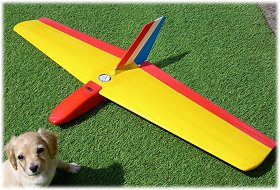 The alternative is the delta-wing and 'flying wing' types and these are common for slope soaring. These gliders are usually just 2-channel with both aileron and elevator controls mixed in to single control surfaces called elevons.
My SAS Wildthing, pictured right, is one such example of the type.
A 2-channel glider, although simple, can still be a lot of fun on the slope, particularly if it has aileron control instead of rudder. Aileron control means that the glider can be rolled more easily, and it just makes the glider more aerobatic and fun to fly.
A foam delta-wing type glider like the Wildthing is durable, generally speaking, which makes it very beginner-friendly.
The more advanced rc gliders and larger sailplanes will have more channels, with additional controls for flaps or spoilers, air brakes, tow line release and retractable nose wheel.
Simpler 2-channel conventional rc gliders like the timeless Goldberg Gentle Lady for example, shown below, are simple to fly and are inherently very stable, making such gliders perfect for the novice.
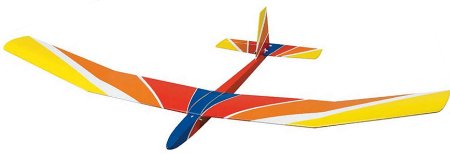
Flying rc gliders of this type can be a very peaceful and relaxing experience. Flying speeds of such gliders are typically slow and their stability gives the pilot plenty of time to react. Gliders like the Gentle Lady are very forgiving in the air and won't punish you for making mistakes with your Tx sticks!
Another timeless classic rc glider, this time a scale type, is the Minimoa. With its beautiful and unmistakable design, the Minimoa makes an excellent scale subject, and they always fly well.
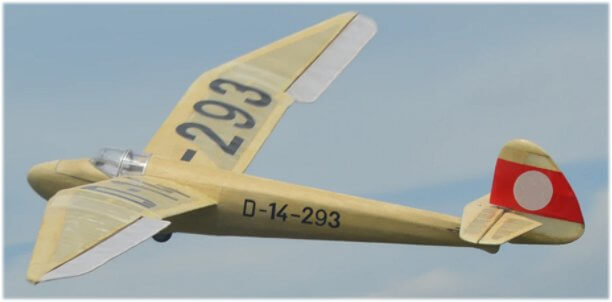
Above: the Minimoa is another timeless classic.
Intermediate/expert RC Gliders
Of course, different types of rc glider and sailplane have different flight characteristics, and at the other end of the scale the sleek racing gliders can be thrown around the slopes at crazy speeds and in stronger winds.
These models are typically moulded from glass fibre and/or carbon fibre, and are commonly referred to as mouldies. They can be ballasted up (made heavier) by inserting metal weights into a special ballast tube inside the fuselage and/or wing, and this extra mass gives the glider more inertia and better penetration into the wind (i.e. makes them fly faster).
Such rc gliders can be very expensive and the faster speeds demand good reactions and co-ordination - this is not the sort of model you want to break due to inexperience!
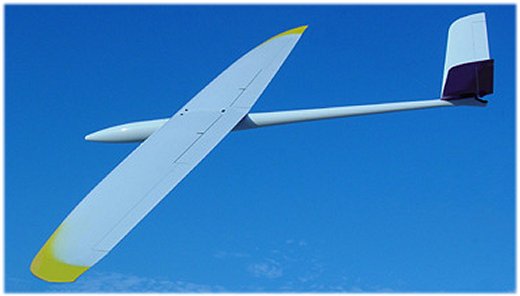
Above: a typical 'mouldie', although this one features a 'V' tail
as opposed to the usual fin and tailplane.
And while on the subject of speed, did you know that the fastest radio control aircraft in the world is a glider?! Not a jet but an rc glider!
Yep, the world record is in excess of 500 m.p.h in the sector of dynamic soaring.
So you can see that radio control gliders offer more than you might expect!
RC Gliding = Longer Flights!
A big advantage that rc gliders and sailplanes have over powered radio control aircraft is that of flight duration
If the conditions are favourable with good lift during a rc slope soaring or thermal flying session then you can keep your glider aloft for a very long time. No need to land for refueling or replacing a motor battery pack, although you do of course need to keep an eye on the transmitter and receiver battery levels to keep the radio signal strong.
It's one of the great things I love about flying my gliders; just being able to soar around the sky without having to worry about my Tx timer beeping for me to land!
RTF vs. ARF vs. Kit RC Gliders
Unfortunately there are few Ready To Fly rc gliders available compared to powered rc planes, and this is a shame for beginners who just want to get flying without any assembly fuss.
It seems that the only RTF gliders around are of the powered variety. Presumably this is a reflection on market demand, and in my opinion it's a shame that at least some manufacturers aren't offering a good selection of 2 or 3-channel RTF gliders for sale.
An Almost Ready To Fly (ARF) glider is the next best option but obviously you're going to have to buy, install and set up the radio gear yourself.
A certain degree of aeromodelling knowledge is required to complete and set up an ARF rc aircraft, but if you're completely new to the hobby there is plenty of help around.
The range of scale ARF gliders from Seagull is a good one, and the quality of Seagull aircraft is very good. Having had a couple of their aircraft, I can vouch for their quality.
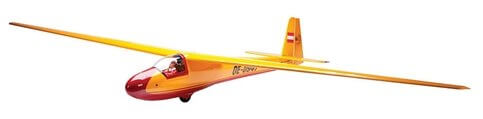
Above: Seagull make some good scale ARF rc gliders, this Ka8-B being one of them.
Of course, ARF rc gliders are a good way of gently introducing you to model plane building techniques!
If you want to seriously get in to the building side of the hobby, then an rc glider kit is the way to go.
Generally speaking (from my experience...) gliders make lovely build projects and I've had a lot of satisfaction from building various gliders over the years.
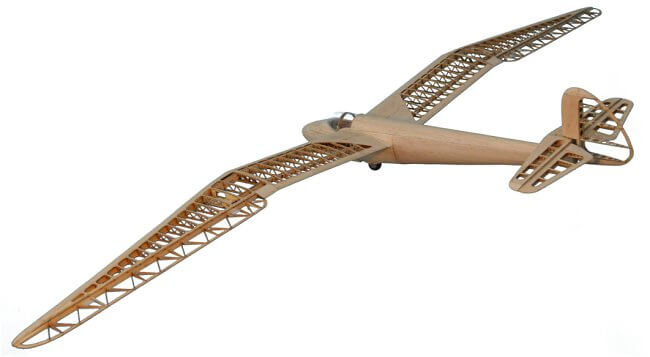
Glider kits like the Minimoa mentioned above are lovely gliders to build, and this Minimoa is available in kit form.
At 1400mm wingspan, it's a perfect size for your slope soaring ventures!
RC Glider & Sailplane Categories
There are several different categories of radio control glider, as well as a large diversity of model designs ranging from general sport gliders to expensive carbon racing ones to large scale vintage sailplanes. Below are some examples of and brief introductions to the more popular types...
General Sport Gliders
These come in a large variety of shapes and sizes and are suited to flat field flying with assisted launch, or the very popular sector of slope soaring.
Typically 3-channel (rudder, aileron & elevator), sport gliders can handle a variety of conditions and are, usually, aerobatically capable. Sport rc gliders can be non-scale or scale, although many scale gliders of this type are labelled as 'aerobatic' rather than 'sport'.
Construction can be traditional balsa and ply or foam such as the popular Multiplex Cularis, shown below, or GRP (glass reinforced plastic aka fibreglass). This latter material is very common in rc glider construction.
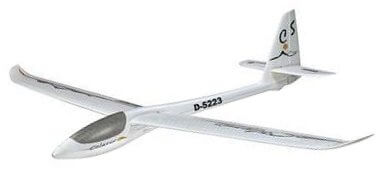
Above: Multiplex have produced some nice foamie gliders, like this Cularis.
Hand-Launched Gliders
 Gliders that are specifically designed to be thrown upwards from a strong hand launch are generally smaller, to make them more manageable. You might see them referred to as chuckies.
A simple 2-channel example is the Great Planes Fling, shown right, although owner feedback about this particular glider hasn't been great. Gliders like this one can also be launched with a simple 'high-start' launching system (catapult / bungee) so if your throws aren't quite strong enough then you can still get airborne. But with the right throwing technique and strength a hand launched glider can easily reach an adequate altitude without any external aids.
Once launched, either by a throw or catapult system, flight duration is achieved by using thermals to keep the glider aloft.
Discus Launch Gliders (DLGs)
Following on from the standard hand launch gliders, a Discus Launch Glider is a type of rc glider that's become very popular with flat-field flyers.
A DLG has a specially designed wingtip handle (a strong pin running vertically through the wing) that is held between index and middle finger. The pilot spins in a 360 degree circle and launches the glider upwards on exiting the spin, just like a field athlete launches a discus (hence the name DLG).
You don't need to be strong because the inertia needed to power the glider upwards is generated during your spin, and then the design of the glider aids the steep climb.
With the right technique a Discus Launch Glider can reach a surprising height. Once the glider has leveled out after its vertical climb, your thermal-seeking can commence.
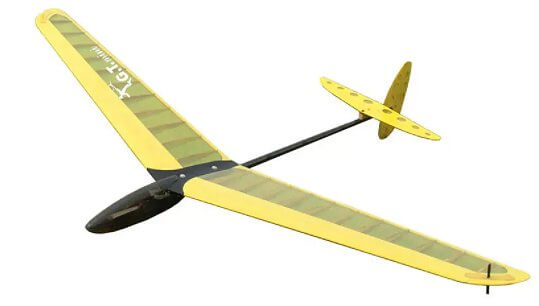
Above: the Yellow GTRC is a good little DLG and one I've had lots of fun with!
The big advantage with a DLG, and indeed a normal hand launch glider, is that you don't need to be on a hilltop or in an area large enough to take a long bungee/Hi-Start system. A DLG can be launched from a relatively small space, as it goes vertically upwards.
Thermal Soarers
RC sailplanes that are intended for thermal soaring tend to have larger wingspans. Their construction is kept as lightweight as possible and they have a low wing loading, this combination keeps their glide rate (vertical descent) to an absolute minimum.
There's a definite skill to thermal soaring. If the pilot can't successfully locate the thermals (columns of rising warmer air) then the glider won't stay airborne for any great length of time. That said, a thermal soarer will out-fly a sport glider (time aloft) under the same conditions, simply because of its better glide rate.
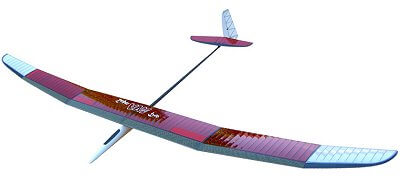
A fairly typical 'pod and boom' type rc thermal soarer is shown below:
Combat RC Gliders
Combat gliders are generally smaller than traditional soarers and are typically made from EPP (Expanded Polypropylene) foam, a material that's incredibly tough and resilient to damage. The tail feathers can be sheet balsa or, more commonly, fluted polypropylene sheet (eg 'Corflute'), a very bendy and crash-resistant material.
EPP combat gliders are commonly covered in reinforced tape to add strength, and then coloured tape to finish. The tape also adds to the durability. Other ways of finishing them include paint and low-heat iron on covering film.
The idea with combat gliding is to fly as a group and try to knock your opponent's glider out of the air. Because the EPP rarely gets damaged, it's quite safe to fly straight into another glider at full speed!
My EPP combat glider is shown below, an 'Eraser' from Canterbury Sailplanes of New Zealand:

Combat gliders are a great deal of fun, but even if you can't get a group together flying one on your own is equally exhilarating. Because of their general design they can be very maneuverable indeed and in the right conditions can be flown fast and aerobatically. Highly recommended for some low-worry slope soaring fun!
Scale RC Sailplanes
A scale model aircraft is one that is modelled from a full size aircraft, and there are plenty of full size gliders and sailplanes that make excellent subjects to model.
A big attraction of such a glider is the build itself, as well as the flying. My 1/5 scale Letov LF-107 Lunak was built from plan. It took me about 18 months and was a very satisfying thing to do.
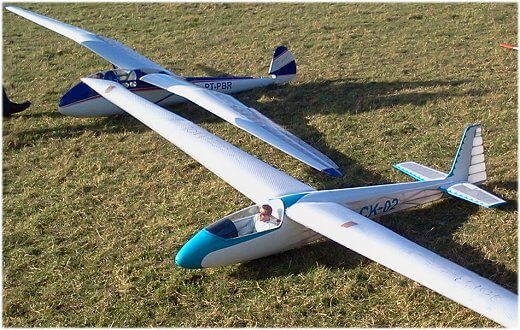
Below is a photo of a fellow clubmate's beautiful large-scale sailplanes, these are about 5 meter wingspan. Obviously not all scale gliders need to be this big!
Well those are just several of the basic categories of rc gliders and sailplanes. As previously mentioned radio control gliders have many types, shapes and sizes from traditional built-up kits meant for relaxed soaring to modern carbon fiber racing machines capable of incredible speeds and performance.
Whichever type of rc glider you choose, you'll be entering a hugely popular sector of the radio control flying hobby. The gentle flying characteristics of many gliders make them a great attraction and introduction to the hobby, and I can highly recommend giving rc gliding a try especially if you live near an open slope that faces the prevailing wind.
Radio control gliding is a hugely popular sector of the rc flying hobby with its dedicated followers, be they slope soarers or flat field thermal flyers. Perfect for the beginner and advanced rc pilot alike, rc gliders and sailplanes will give you a truly rewarding experience.
From a personal point of view, rc gliders are my favourite form of radio control flight. They require very few accessories and there are no noise issues to worry about. In fact, the only real concern is whether or not your radio gear batteries will last as long as you want to fly for!
The challenge of having to seek out lift and use the air to keep your glider aloft, rather than just rely on motor power and thrust, is an addictive and exhilarating one. Why not give it a go?!
You might also like to read about...

All of this and much more is covered in our Beginner’s Guide 👇
The Beginner’s Guide To Flying RC Airplanes is a 139-page, easy-to-read e-book written for complete newcomers. It explains exactly what to buy, where to fly, and how to avoid costly mistakes.
📖 Start reading now